fb icon

fb icon
Follow E-tek on fb!

November 16, 2012

From wiring to metalwork


Test-fit the Headlight buckets and re-wired them for the single sealed beams and combined park/marker lights:


Left the pigtails off, ready to be connected after paint:


Hot rods require a completely different process than restorations. When I do a restoration, I pretty much know that everything will go back together where - and how - it should, With hot rods, you basically have to build it twice (or more) - once to get everything to fit and work, then you disassemble it all for paint and then rebuild it again to make it pretty!

Did some reading on these hoods and found that the latch plate causes a lot of issues with the hood - both in alignment and damage done due to the repeated flexing. My plan to strengthen both sides is to double-up both the hood edge and the lock plate mounting tab areas:

 This is where the hoods edge had cracked. I welded it up - inside and out - and will metal finish it after I welded a second layer of metal along the bottom lip.


Below is the latch panel. You can see it's bolted right at the very (thin) edges.
 Here you can see the mounting holes on the latch panel. Not a lot of strength there.
 I first flattened the areas that had been bent out of shape from where the bolts attach it to the hood.
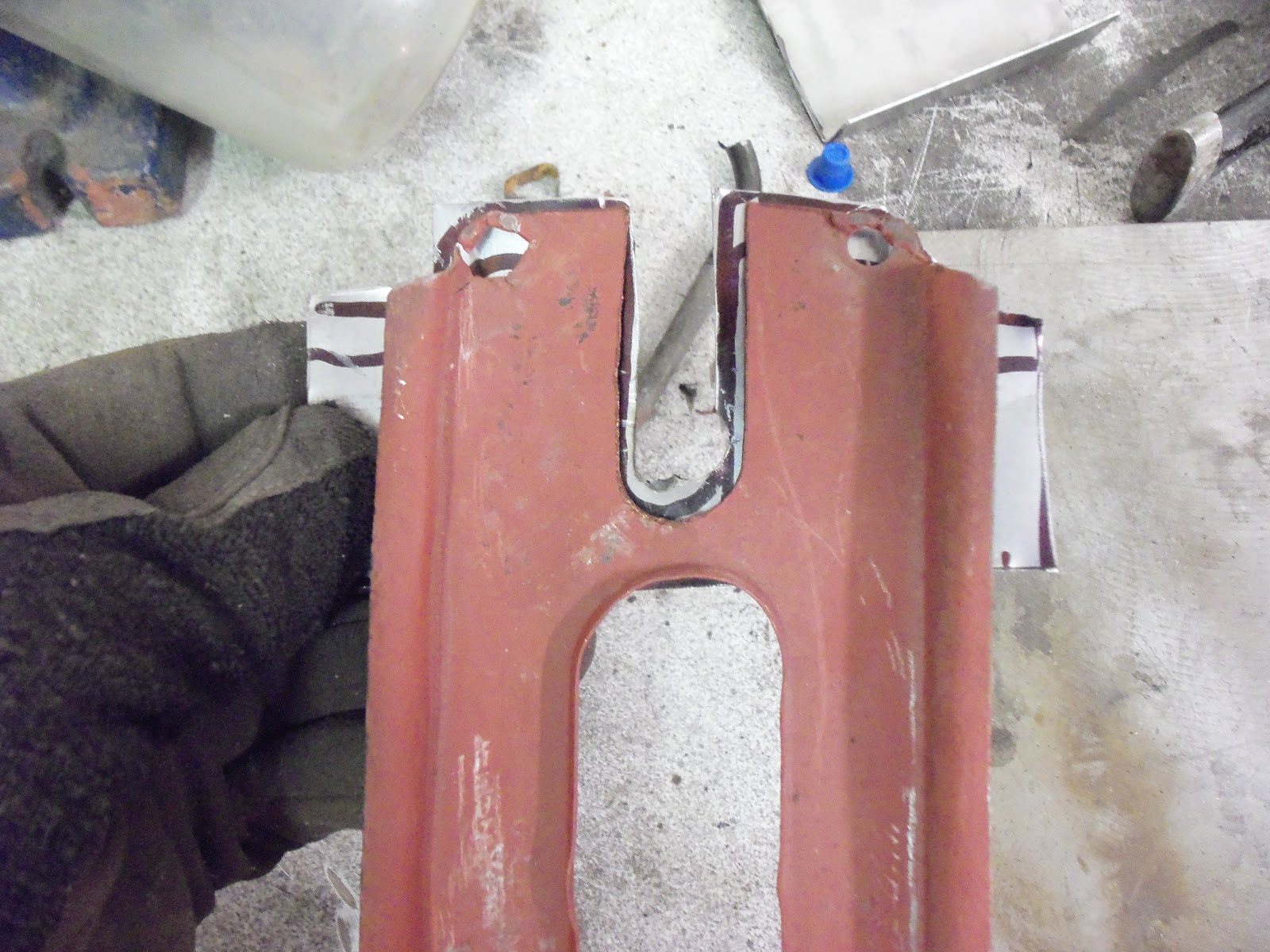
 Then I fabricated a piece to be welded to the original, doubling up the weak area. Similar pieces will be make for each corner.


This electric shear might be the best metal tool I've ever owned - easy peasy!


Now that it's trimmed to shape I'll clean up the edges, weld it to the top-side of the original panel and it'll be completely hidden. Should add a lot off strength to problem area.


November 15, 2012

Parts painting booth

Whether you restore an entire car - or are rebuilding a carb, lawnmower, old tools or furniture - at some point you'll have some painting to do. From a few bolts to a bunch of parts from an assembly, you'll want to have a dedicated spot to paint them - and there's a variety of reasons to do so.

Firstly, you want the parts to remain clean for painting. There's nothing worse than meticulously preparing them only to have dust and dirt particles in the finished product. Next to keeping the parts clean, it's nice to keep you shop clean as well. Painting creates overspray, which ruins floors, tools, as well as other parts and projects close by (and sometimes far away!).

Something I've noticed many home (and even professional) restorers ignore are painting and baking temperatures. Higher temperatures are critical to proper painting and curing. Paint flows better, dries faster and flashes-off more completely when above "room" temperature. Most importantly is that the parts, paint and ambient air is at least 20C/72F, but by raising the temperatures even further - into the mid 30'sC (100-120F) -  you'll get far superior results: better flow, gloss and durability.

My current projects are not at the stage where I need a dedicated parts booth, so to save space I have it disassembled and stored in the corner of the shop.  Since I like to do things right, I decided to take the 10 minutes it would take to put together the pieces from the stored parts. The added heat in a cool shop,the ability to contain the overspray and keep the parts clean was worth it. You can see I also warmed the paint by setting it in front of the space heater for about 10 minutes.


Everything was first coated with an etching primer to maximize adhesion, then a mist coat of paint was followed with 3 heavier coats for coverage and flow. To some they are "just" headlight pots, but everything in the E-tek shop gets the same top-end  treatment!


After all was painted I covered it up with a thick sheet to maintain the temperatures and keep out any dust while the parts cured overnight.


Next up were the oil cooler lines from the transmission. A reducer was used to get the Ford lines to fit the aftermarket rad:


You may recall that the lines where cut in our last 'episode". Here I bolted them up to mark the cuts, then cut them to size and connected them temporarily (for run up) with 3/8 inch rubber hose. Permanent hydraulic hoses with crimped fittings will be made up with the AC fittings.


Lastly today I ran the positive wire up through the floor and hooked up a side-post battery.
 Being sealed it won't require a vent, but will be "boxed" before going to the upholster shop.


November 11, 2012

Owner lends a hand

 At certain points in the building of a rod, you really need the owner/driver to be on hand - yet we often hear how cars languish in shops for years on end without so much as a call and with little or no consultation between owner and technician. There's seat height, leg room length, pedal and steering wheel placement, console shape and location of the many components and much more. As well, most of the cars and rods I do are owned by those interested in doing some of the work themselves, so along the way they sometimes come over to the E-tek Shop to get their hands dirty, work with me on style and fitment and generally enjoy parts of the process. Such was the case today.


As we were discussing various parts of the built, the owner noted that I had the AC and tranny cooler lines mixed up (not sure what I was thinking there!). The tranny cooler lines from the 5.0L's transmission must have connected to a side-mounted cooler in the original "donor" vehicle and they lined up perfectly with the AC cooler lines on this rad, so I was under the impression that was where the connection was to be made. These were going to be connected by a Rad/AC shop off-site, but with this realization, we were able to cut and bend the tranny cooler lines and now - with some reduction fittings and a couple lengths of hose - I'll be able to get them connected for the initial run-up. The AC cooler (crimped) lines and charge can be done much later.


Also got some metal work done today on the hood in order to bolt up the latch panel. What I'll do this time is add a long piece to reinforce the edge where it attaches so as to stop this from occurring again. The edge obviously moved every time the hood was opened/closed (and maybe even while driving), causing the stress fracture.


Dismantled the headlight pots for sandblasting:


Lots more to come - hope you can come back weekly and join us!

November 9, 2012

Center Console Mock Up & Hood Repair

Re-installed the bare dash panel in order to begin the mock up of the center console:


Started with some bristol board - which is easy to cut and shape:


Once I had the side shape done I traced it onto a piece of 3/16" fiber board:


I cut two sides and a front panel and then screwed it all together with some wood blocks in between:


After some quick shaping and some adjustments, I installed it in place in the car. Looks pretty good for a first go!


Once the general shape is decided on, the hard work can begin. Car audio guys are experts at this kind of work as they build a lot of custom consoles, amp and speaker enclosures. Starting with an MDF buck, fabric is draped and stapled over to start the rounded edges, then it's all filled and shaped with fiberglass and body filler. A custom console like this may end up with 30 hours or more into it.


 With that part done for now, the hood had some damage that I needed to address in order to mount it later.


After a quick pass with the grinder, I saw what appeared to be lead filler. The grinder marks are much deeper in the soft lead.


A quick swipe with the torch proved my hunch.


...and within seconds it was on the floor.


Another swipe with some coarse steel wool and it was all gone.


Now we can see the cracked edges that need welding right were the latch  plate bolts on. It doesn't look like it was welded in the prior repair many years back and if it had even a tiny crack it would have gotten worse with the constant flexing that would occur every time the hood was closed and latched. I'll be sure to strengthen this area to ensure that won't happen again.


Don't forget to check out my website at 
www.E-tekRestorations.com!

November 8, 2012

More Wiring, Seats, Dash vents


Finalized the fan wiring on the 40 Ford with a 40Amp relay:


Mounted other engine relays to the inner fender:


Wired up the water temp and alternator leads:


Put it all in wire looms, then bolted the front end back together:


 Inside, I re-arranged the pedals as per owners request (surprise!)


Then removed the seats in order to fabricate some mounting tabs so they could be bolted in:


The seats supplied had these tabs in front that clipped into holes in the original vehicle:


Which needed to be removed and some feet welded on in their place that could be bolted down.
I turned the seats over on a stool and taped cardboard down in order to protect the seats from burns:


Off came the tabs:


New feet cut and drilled:


Then welded onto the seat bottoms:


I then turned the seats over and welded the tabs from the top-side. We don't need them coming apart!


The seats were re-positioned, holes drilled in the floor panel and then they were bolted in using spacers to get them leveled out. I used pieces of wood for now, but will try to source something else for a permanent solution.


 These side vents are supposedly made to fit these holes in the 40 Ford dash. They don't fit very well no matter which way I inserted them....


I'll have to either re-work the edges to even them out, or find some type of bezel that could fill in the gaps...


Tomorrow we'll be able to put the dash in loosely in order to begin the initial mock up of the console. Lots of "big changes" coming up!


Don't forget to check out my website at 
www.E-tekRestorations.com!